

Lymphatic drainage after a knee replacement reduces post-operative swelling, supports the return of functional movement, and lowers the risk of complications such as cellulitis and fibrosis. Sessions typically begin five to seven days after your operation, once the surgical site is stable, and always in consultation with your surgical team. After a joint replacement in particular, the swelling is not a cosmetic problem — it is the thing limiting the range of movement your physiotherapy depends on.
This is the patient's version of our post-operative lymphatic drainage protocol: what the swelling is, why it lingers at exactly the point you have been told to rest, and where drainage fits around the rehabilitation you have already been given.
Why does a new knee swell so much?
Surgery, however routine, creates trauma to the surrounding tissue. That trauma triggers an inflammatory cascade. The lymphatic system — the network responsible for clearing excess fluid and metabolic debris out of your tissues — is often overwhelmed at exactly the time you are least able to move.
Joint replacement adds a second problem on top of the first. The surgery disrupts the lymphatic network around the operative site itself, which creates significant post-surgical oedema, and that oedema directly limits the range of movement needed for effective physiotherapy. You are being asked to bend a joint that is full of fluid.
Your lymphatic system has no pump
That is the single fact this whole article rests on. Your circulatory system has a heart driving blood around the body whether you cooperate or not. Your lymphatic system has nothing equivalent — it is propelled entirely by muscle contraction, movement and breath.
So when you are forced to rest after an operation, it slows dramatically. This is not merely uncomfortable. A sluggish lymphatic system during recovery means:
- Slower fluid clearance
- More persistent swelling
- A heavier inflammatory burden
- An impaired immune response
- An increased risk of post-operative complications, including cellulitis
The result is often that patients feel heavier, more fatigued, more demotivated, and less equipped to do the rehabilitation work that determines their long-term outcome. That last part is the one that compounds. The rehab is what decides how the knee ends up, and it is being asked of you at the point you have least in the tank.
When can I start, and how often?
Based on published post-operative lymphatic drainage guidelines, the framework below is the one we work to — always in consultation with your surgical team.
- Days 5 to 7 — the earliest point to begin, once the surgical site is stable. Gentle, broad lymphatic stimulation begins to move post-surgical fluid away from the area.
- Weeks 1 to 4, two to three sessions a week — the most critical window. Regular sessions at this frequency significantly reduce swelling, lower the risk of fibrosis, and accelerate the return of functional range of motion.
- Weeks 4 to 8 and beyond, one session a week — maintenance and consolidation. Weekly sessions sustain lymphatic flow, support scar tissue management from week six once the skin is fully closed, and continue to support the immune response.
Always follow your surgeon's specific post-operative guidance ahead of anything written here. Scar tissue work begins only once the wound is fully closed and shows no signs of infection, which is typically six to eight weeks after surgery.
What a session actually involves
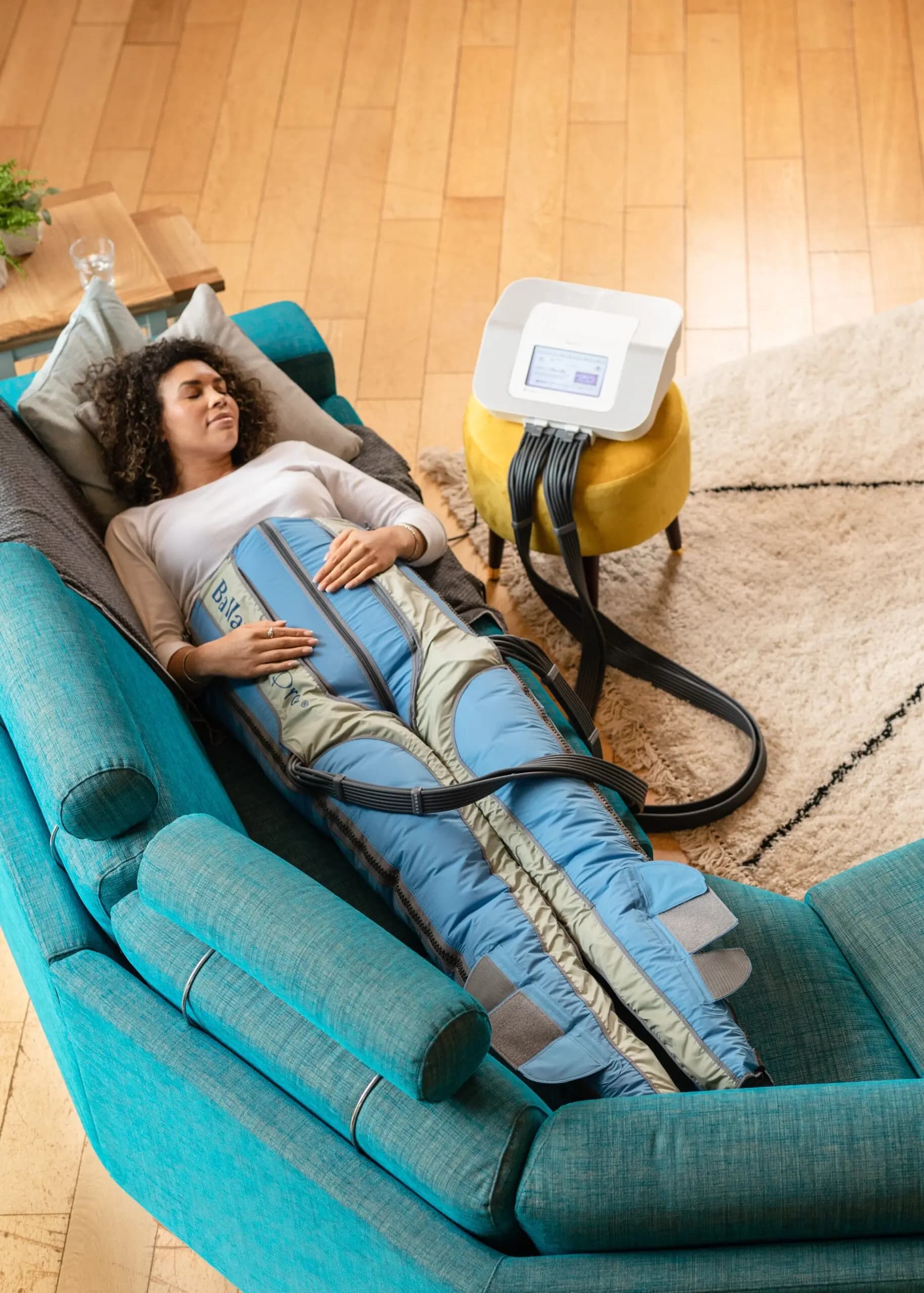
You lie down, fully clothed in loose comfortable layers, and a full-body compression garment is fitted over your legs, abdomen and torso. The Body Ballancer then works through 24 independently controlled overlapping chambers in a sequenced wave — starting at the extremities and moving toward the core, following the physiological direction of lymphatic flow. It does mechanically what walking briskly for hours would do naturally, which is precisely the thing you currently cannot do.
The treatment runs 45 minutes and the appointment is booked as an hour, so there is time to get settled and fitted rather than being hurried. The pressure is gentle and fully adjustable to your comfort — most people describe it as closer to a full-body massage than a treatment, and a fair number fall asleep. There is no downtime.
One thing to expect: you will need the loo more often the day and possibly consesecutive days after.
What difference does it make to the first few weeks?
Lymphatic drainage has been shown to reduce post-surgical swelling from the first session, improving comfort, accelerating the return of mobility, and allowing patients to engage more productively with their rehabilitation programme. One total knee replacement patient put it this way:
"From the first session, the swelling visibly reduced and moving became easier. By the end of the programme, my recovery was ahead of everything the surgical team had predicted."
Individual results vary, and the honest framing is that drainage clears the obstacle rather than doing the rebuilding. The physiotherapy is still what gets the knee back. Drainage is what gives the physiotherapy something to work with.
Who it is not for
Common contraindications include active infection at or near the surgical site, open wounds, deep vein thrombosis, severe heart conditions, a pacemaker and certain skin conditions. We review your individual circumstances before a first session, we work alongside your surgical team's guidance, and we will decline to treat where it is not appropriate. That consultation is not a formality — it is how we check.
Common questions
How soon after surgery can I start lymphatic drainage?
The earliest typical starting point is five to seven days after your operation, once the surgical site is stable. This varies by procedure and by patient, so we ask you to confirm the timing with your surgeon or surgical team before your first session. We are happy to work alongside their guidance.
How many sessions will I need?
Most post-operative protocols run two to three sessions a week for the first four weeks — the window where drainage makes the most difference — then reduce to weekly for weeks four to eight. The blocks of five and ten sessions exist for exactly this pattern, and work out at £40 and £35 a session respectively.
Will it help with the scar?
Scar tissue work is part of the later phase of the protocol, and only begins once the wound is fully closed and shows no signs of infection — typically six to eight weeks after surgery. Before that point, sessions focus on fluid clearance and swelling rather than the scar itself.
Does it hurt?
No. The compression is gentle and rhythmic and the pressure is adjustable throughout. Most people find it deeply relaxing.
What should I wear?
Loose, comfortable clothing — leggings or joggers and a t-shirt are ideal. You stay fully clothed for the session.
Tired of being tired? Book a free 15-minute discovery call and we'll work out what's draining you.
Book Free Call →What it costs and where sessions run
A single 45-minute session is £45. A block of five is £200, which works out at £40 a session, and a block of ten is £350, at £35 a session. The blocks are not an upsell — a post-operative course is a course, and that is the honest pricing for the way it is used.
Sessions run at two sites on a weekly rota. Thursday to Saturday they run at Stocks House near Southport. Sunday to Wednesday they run from a private treatment room near Preston, and the address is confirmed when you book. You choose your site first, and the calendar then only shows you the days that site runs.
The bottom line
You have been given a new joint and a rehabilitation programme, and then told to rest — which is the one thing that stops your lymphatic system clearing the swelling the programme is fighting against. Drainage addresses that directly, and the window where it makes the most difference is the first four weeks.
If you are not yet sure whether it suits your situation, a free 15-minute call is the sensible first step. Tell us what you have had done and what your surgeon has said, and we will tell you honestly whether and when to start.
The Body Ballancer is a medical-grade therapeutic device and all sessions are delivered by a qualified practitioner with 25+ years of clinical experience. Individual results may vary. This article is for information and does not constitute medical advice — always consult your healthcare provider before starting any new therapeutic protocol, particularly following surgery or medical treatment.