

Lymphatic drainage is not a sports therapy. It is a therapy for people whose bodies do not move enough, which in practice means almost everyone — and the less you move, the more you need it. Athletes recover from what they did. Everybody else is recovering from what they didn't: eight hours in a chair, a long drive, a day spent standing in one spot.
We have written already about what the Body Ballancer Pro does for athletes and gym members. That article gets read by coaches. This one is for the people who actually fill most of the appointment book: the office worker, the parent at home, the sales rep who lives in the car, the woman going through menopause who cannot work out why her rings do not fit by teatime.
Who actually books a session?
In a typical week, the diary looks nothing like a performance centre. It looks like this:
- People with desk jobs — accountants, admin staff, anyone who spends the working day seated, then commutes seated, then sits down in the evening.
- Parents at home with young children — physically exhausted, constantly lifting and carrying, but rarely doing the sustained rhythmic movement that actually shifts lymph.
- Drivers and people who travel for work — reps, hauliers, anyone doing three hours behind the wheel before their first meeting.
- People on their feet in one place all day — hairdressers, teachers, retail and hospitality staff, nurses. Standing still is not the opposite of sitting still; both leave fluid pooling in the lower legs.
- Women in perimenopause and menopause, dealing with fluid retention, puffiness and a heaviness that arrived without any change in diet or activity.
- Anyone recovering from an operation or an injury, in the weeks when they have been told to rest — see our post-operative recovery pathway for that specific protocol.
The common thread is not fitness. It is stillness.
Why is sitting still a lymphatic problem?
Your lymphatic system has no pump. That is the single fact this whole article rests on. Your circulatory system has a heart driving blood around the body whether you cooperate or not. Your lymphatic system — the network responsible for clearing excess fluid, metabolic waste and inflammatory debris out of your tissues — has nothing equivalent. It is propelled entirely by muscle contraction, movement and breath.
Which means it moves when you do, and slows when you don't. Sit for eight hours and your lymph is largely parked for eight hours. Fluid that should be clearing out of the tissue in your legs, abdomen and pelvis sits where it is. Waste that should be leaving stays put. This is not dramatic and it does not hurt, which is exactly why it goes unaddressed for years.
An athlete with congested lymph notices immediately, because their performance drops and they have a number to look at. A person with a desk job has no number. They just gradually accept feeling heavier and duller than they used to.
The signs you have probably stopped mentioning
Sluggish lymphatic flow rarely announces itself. It shows up as a collection of small things that are individually easy to live with:
- Persistent fatigue that sleep does not seem to fix
- Bloating, particularly through the afternoon and evening
- Puffy skin, tight rings, sock marks, fluid retention
- Brain fog
- Catching every bug that goes round
- Low motivation
- Skin breakouts and dull skin tone
- Cellulite that has not responded to anything you have tried
None of these are alarming on their own. That is the problem — they get absorbed into what you assume is just being in your forties, or being busy, or being a parent. Most people only notice how much they were carrying once it lifts.
What a session actually involves
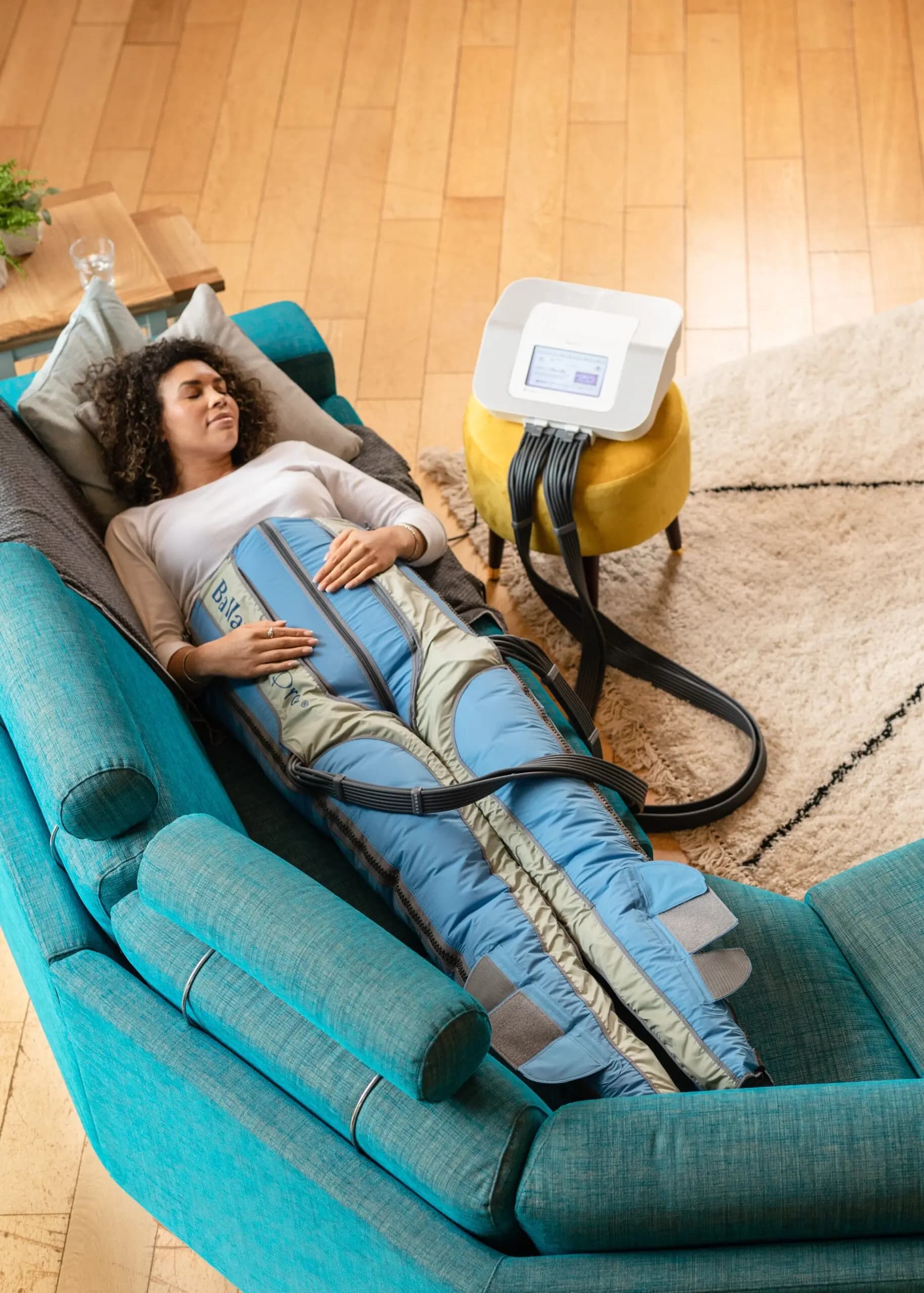
You lie down, fully clothed in loose comfortable layers, and a full-body compression garment is fitted over your legs, abdomen and torso. The Body Ballancer then works through 24 independently controlled overlapping chambers in a sequenced wave — starting at the extremities and moving toward the core, following the physiological direction of lymphatic flow. It does mechanically what walking briskly for hours would do naturally.
The treatment itself runs 45 minutes, and the appointment is booked as an hour — the extra quarter of an hour is there for getting settled, fitting the garment and getting yourself together afterwards, so you are not being hurried out of the door. The pressure is gentle and fully adjustable to your comfort — most people describe it as closer to a full-body massage than a treatment, and a fair number fall asleep. There is no downtime and you can drive home and carry on with your day.
One thing to expect: you will need the loo more often that evening. That is the point rather than a side effect — it is the fluid leaving. Feeling thirsty, or tired and ready for an early night, is also normal. Keep drinking, aim for 1.5 to 2 litres across the rest of the day, and sleep when you want to.
What changes after one session, and after a course
The same day
A single session is worth having on its own, and most people feel the difference before they leave. The two things reported most often are lighter legs and a clearer head — fluid that had pooled in the tissue finally having somewhere to go, and metabolic waste clearing out rather than sitting there. Clients also commonly report feeling looser through the hips, shoulders and back, and visibly less puffy through the abdomen.
Over a course of five to ten
One session moves what has built up. A course, taken weekly or fortnightly, is what stops it rebuilding in between — and that is where the lasting change comes from. Over a course, clients report that the bloating and heaviness stop returning between sessions, that skin looks firmer and cellulite becomes less pronounced, that energy is steadier day to day, that they move more freely, and that they sleep better.
That last one has a mechanism worth knowing about. The brain has its own overnight waste-clearance network — the glymphatic system — and it drains into the lymphatic vessels of the neck. Open pathways during the day give it better conditions to work in at night. We have written that up separately in the brain and glymphatic health pathway.
Individual results vary, and how long the effect holds depends a great deal on what you go back to between sessions. A weekly session will not undo a life with no movement in it — but it will keep the system draining while you work on the rest.
Is this not just an expensive way to lose water weight?
It is a fair question and the honest answer is that some of what you feel on day one is fluid, and fluid comes back if nothing else changes. The reason a course is recommended rather than a single session is precisely that: repeated drainage improves the quality of the tissue itself rather than temporarily manipulating water retention. That is the difference between the immediate lighter-legs effect and the slower change in skin texture and cellulite, which is covered in the cellulite and skin health pathway.
It is also worth saying what this is not a substitute for. It does not replace movement. If you sit all day, the session helps enormously and a daily walk helps more. The two are not in competition.
Who it is not for
Body Ballancer is not suitable for everyone. The common contraindications are active infections, deep vein thrombosis, severe heart conditions, pregnancy and certain skin conditions. That is why there is a brief consultation before a first session — it is not a formality, it is how we check. If you have any health condition at all, tell us about it beforehand and we will talk it through.
What it costs and where sessions run
A single 45-minute session is £45. A block of five is £200, which works out at £40 a session, and a block of ten is £350, at £35 a session. The blocks exist because a course is what most people actually need — they are not an upsell, they are the honest pricing for the way the treatment works.
Sessions run at two sites on a weekly rota. Thursday to Saturday they run at Stocks House near Southport. Sunday to Wednesday they run from a private treatment room near Preston, and the address is confirmed when you book.
That second one is worth saying plainly rather than glossing over. A session means lying down for three quarters of an hour in a full-body compression garment, and a fair number of people would far rather do that somewhere quiet than in a clinic with a waiting room and people coming and going. It is a private room, by appointment, with nobody else in it — which for this particular treatment is the point, not a compromise.
You choose your site first when you book, and the calendar then only shows you the days that site runs.
Tired of being tired? Book a free 15-minute discovery call and we'll work out what's draining you.
Book Free Call →Common questions
Do I need to be fit to have a session?
No. If anything, the less you move in an ordinary week, the more there is for a session to shift. You lie down for the whole 45 minutes and the machine does the work.
How often should I come?
Many people have a single session as a standalone treatment and are glad they did. For a noticeable and lasting change, a course of five to ten sessions taken weekly or fortnightly is what we would normally suggest.
How long should I allow?
An hour. The compression itself runs for 45 minutes and the appointment slot is an hour, which covers getting changed, fitting the garment and a few minutes at the end rather than being rushed straight back out.
Does it hurt?
No. The compression is gentle and rhythmic and the pressure is adjustable throughout. Most people find it deeply relaxing.
What should I wear?
Loose, comfortable clothing — leggings or joggers and a t-shirt are ideal. You stay fully clothed for the session.
Can I just take lymphatic drainage herbs instead?
They do a real job, but not this one. Herbs like dandelion, milk thistle and cleavers work on the liver and kidney end of the chain and are mildly diuretic, which supports the processing side of detoxification. What nothing taken orally can do is move lymph, because lymph has no pump. When movement is limited by a desk job, an injury or surgery, no supplement substitutes for the mechanical work. The two support different parts of the same chain, which is why we sell them together rather than as alternatives.
Is there anything I should do afterwards?
Drink plenty of water, expect to need the loo, and do not plan anything demanding for that evening if you can avoid it. Otherwise carry on as normal — there is no downtime.
The bottom line
The lymphatic system is the most commonly overlooked variable in general wellbeing, and modern life is close to purpose-built to congest it. You do not need to be training for anything to benefit from clearing it. You need to be someone whose body does not get moved enough — which describes most of us, most weeks.
If the list of signs earlier in this article read like a description of your last six months, that is the reason to book, and 45 minutes is enough to find out whether it makes a difference to you.
The Body Ballancer is a medical-grade therapeutic device and all sessions are delivered by a qualified practitioner with 25+ years of clinical experience. Individual results may vary. This article is for information and does not constitute medical advice — always consult your healthcare provider before starting any new therapeutic protocol, particularly following surgery or medical treatment.