

Delayed onset muscle soreness is the result of micro-trauma and the subsequent inflammatory response in muscle tissue. What shortens it is clearing those inflammatory by-products out of the tissue, and that job belongs to your lymphatic system — which, unlike your circulation, has no pump of its own. Lymphatic compression does that work mechanically, and it does the most when it is booked directly after the hardest training session of your week.
Sessions run Sunday to Wednesday from a private treatment room near Preston, and Thursday to Saturday at Stocks House near Southport.
Why are you sore two days later rather than on the day?
Because your muscles do not recover during training. They recover after it, during the period when the body clears the metabolic debris that session generated — lactic acid, inflammatory cytokines, reactive oxygen species and cellular waste products.
DOMS is what that clearance looks like when it is running behind. Inflammatory by-products pool in micro-damaged muscle tissue, and the soreness builds as they accumulate. Clearing that fluid before it peaks reduces both the intensity and the duration of the soreness.
The part nobody teaches you: lymph has no pump
Your cardiovascular system has a heart driving blood around whether you cooperate or not. Your lymphatic system has nothing equivalent — it moves entirely through muscle contraction and movement. When training is intense, when you are tired, or when soreness limits movement, lymphatic flow slows. Waste accumulates. Inflammation builds. Recovery time extends.
Which is the awkward loop in the middle of a hard week. The soreness is what stops you moving, and not moving is what keeps the clearance slow.
When should I book it?
Directly after the hardest training session of your week. That is when the inflammatory load in the tissue is highest and when clearing it makes the most difference to how quickly you are ready to train again. The session can also be adapted to target the muscle groups that took the greatest load, so it is worth saying what you did when you arrive rather than afterwards.
Through a heavy training block, weekly is typical. For maintenance, fortnightly. The blocks of five and ten sessions are priced for that cadence, at £40 and £35 a session respectively.
What does the research show?
Studies on pneumatic compression therapy in athletic populations consistently demonstrate reductions in perceived muscle soreness of 30–50%, accelerated return-to-training timelines, measurable improvements in lower limb circulation, and significant reductions in inflammatory biomarkers post-exercise.
Being straight with you about that range: it is what the published work on pneumatic compression reports across athletic populations, not a measurement taken on you in this room. What clients here report after 45 minutes is feeling lighter, less sore and noticeably more recovered — and that it compounds with consistent use across a training programme rather than arriving all at once.
Recovery is not the only thing it is doing
Unless you have been in a collision — a car accident, a rugby tackle, a sudden traumatic event — the vast majority of injuries are not random. They are the predictable result of imbalances that accumulate quietly, over months and years, until the point of failure.
Your body is highly adaptive. It moulds itself to the positions and demands you place on it, and when those demands are uneven, imbalanced or repetitive, the consequences are structural. Prolonged sitting tightens the hip flexors and quadriceps whilst the glutes progressively disengage — and tight hip flexors with inactive glutes are one of the most well-evidenced contributors to lower back pain and hip pathology.
The patterns we address most often:
- Desk worker hip pattern — shortened hip flexors, inhibited glutes, anterior pelvic tilt: the foundation of most chronic lower back pain.
- Runner's fascial loading — ITB tightness, plantar fascia restriction, and calf and Achilles overload from repetitive unilateral loading.
- Cyclist's anterior chain dominance — compressed hip flexors, thoracic kyphosis, neck tension, creating shoulder and knee vulnerability.
- Swimmer's shoulder — overloaded rotator cuff and lat dominance creating internal rotation restriction and impingement risk.
- Team sport asymmetry — dominant leg loading, adductor and abductor imbalance, and repetitive rotational forces through the lumbar spine.
- Post-surgical compensation — the whole body adapts its movement around pain, creating secondary imbalances that outlast the original injury.
Regular fascial and lymphatic work is not simply recovery. It is maintenance of the human machine — the same way you think about servicing a car. Consistent, proactive attention prevents the breakdown that costs far more, in time, pain and lost training, than the maintenance ever would.
Do I need to be an athlete for this?
No — and the desk worker hip pattern above is the single most common thing we see. You do not need to be an athlete to accumulate the loading imbalances that cause injury; a sedentary job produces them just as reliably as a training programme does. If you train three times a week and sit down for the other forty hours, both halves of that are in the room with you.
What a session involves
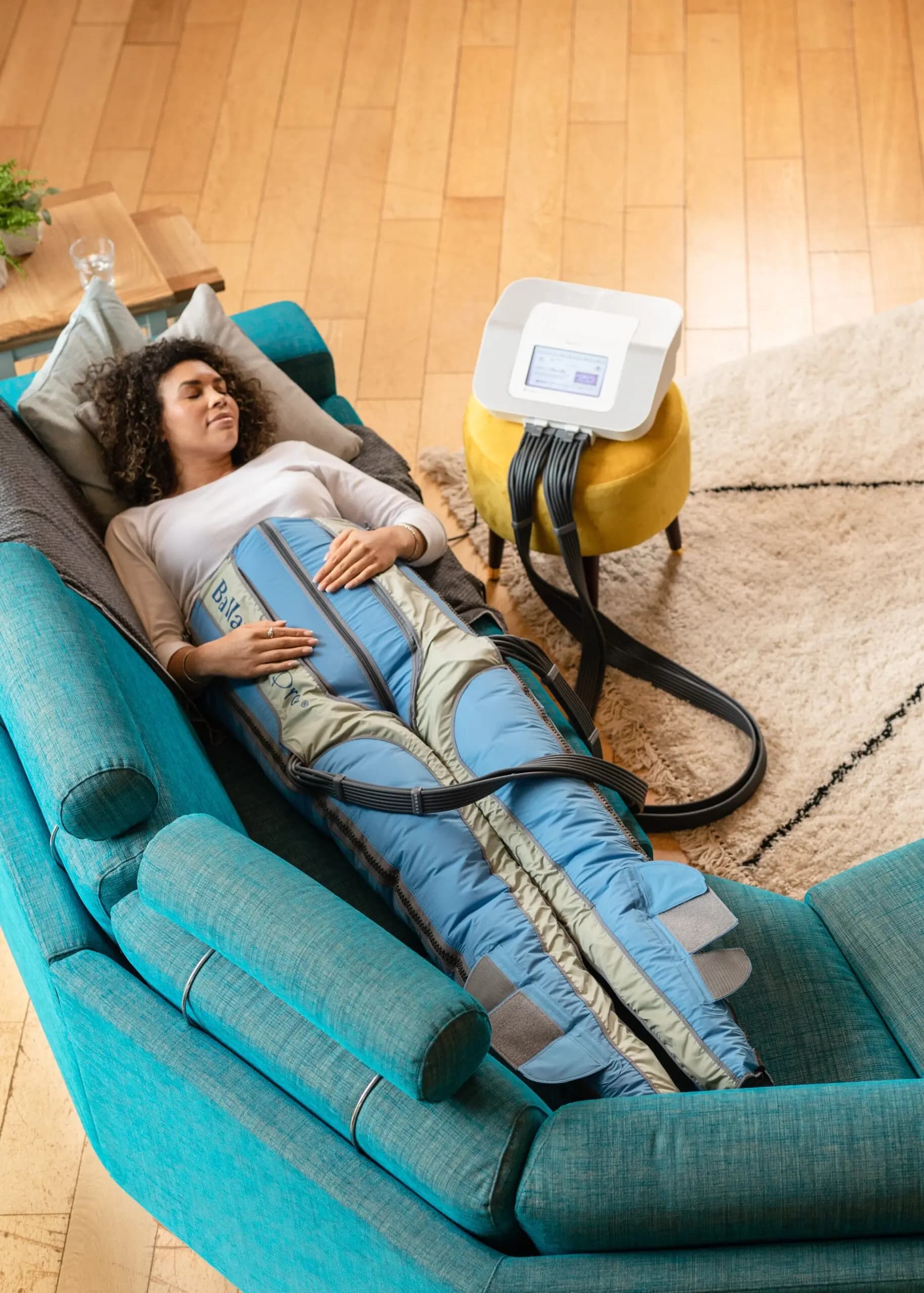
You lie down, fully clothed in loose comfortable layers — leggings or joggers and a t-shirt — and a full-body compression garment is fitted over your legs, abdomen and torso. The Body Ballancer works through 24 independently controlled overlapping chambers in a sequenced wave, starting at the extremities and moving toward the core, following the physiological direction of lymphatic flow.
The treatment runs 45 minutes and the appointment is booked as an hour. The pressure is gentle and rhythmic and adjustable throughout — most people describe it as closer to a full-body massage than a treatment, and a fair number fall asleep. There is no downtime; you can drive home and carry on with your day.
Two things to expect afterwards. You will need the loo more often that evening, which is the fluid leaving rather than a side effect, so keep drinking — 1.5 to 2 litres across the rest of the day. And you are likely to sleep well: the rhythmic, wave-like compression activates the vagal nervous response, shifting the body from sympathetic dominance toward rest-and-recover mode, which is the state the nervous system needs after hard training.
Where the Preston sessions run
Sunday to Wednesday, from a private treatment room near Preston, with the address confirmed when you book. Thursday to Saturday, at Stocks House near Southport. You choose your site first, and the calendar then only shows you the days that site runs.
That first one is worth saying plainly rather than glossing over. A session means lying down for three quarters of an hour in a full-body compression garment, and a fair number of people would far rather do that somewhere quiet than in a clinic with a waiting room and people coming and going. It is a private room, by appointment, with nobody else in it.
A single 45-minute session is £45. A block of five is £200, at £40 a session, and a block of ten is £350, at £35 a session.
Tired of being tired? Book a free 15-minute discovery call and we'll work out what's draining you.
Book Free Call →Who it is not for
Body Ballancer is not suitable for everyone. The common contraindications are active infections, deep vein thrombosis, severe heart conditions, pregnancy and certain skin conditions. That is why there is a brief consultation before a first session — it is not a formality, it is how we check. If you have any health condition at all, tell us beforehand and we will talk it through.
It is also worth saying what it does not replace. It does not replace sleep, food or sensible programming. If you are sore for four days every week, a session helps and a look at your training load helps more. The two are not in competition.
Common questions
Can lymphatic drainage really prevent injury, or just help me recover?
Both, but by different mechanisms. Recovery is the clearance of inflammatory by-products after load. Prevention is the fascial side of the work — restoring suppleness to tissue that has become restricted through repetitive loading, and addressing the imbalances that build quietly until something fails.
Should I come before or after a hard session?
After. Directly after the hardest session of the week is where it does the most, because that is when there is most to clear.
How often should I come?
Weekly through a heavy training block is typical, dropping to fortnightly for maintenance.
Does it hurt?
No. The compression element is gentle and rhythmic and pressure levels are adjustable to your comfort. Myofascial release work can be more direct, and we work within your tolerance.
How long should I allow?
An hour. The compression itself runs for 45 minutes and the appointment slot is an hour, which covers getting changed, fitting the garment and a few minutes at the end rather than being rushed straight back out.
The bottom line
DOMS is a clearance problem, and clearance is the part of recovery you have least direct control over — your lymphatic system moves when you move, and after a hard session moving is exactly what you do not want to do. Forty-five minutes of sequential compression does that work for you, and it does the most when it is booked straight after the session that did the damage.
The Body Ballancer is a medical-grade therapeutic device and all sessions are delivered by a qualified practitioner with 25+ years of clinical experience. Individual results may vary. This article is for information and does not constitute medical advice — always consult your healthcare provider before starting any new therapeutic protocol, particularly following surgery or medical treatment.