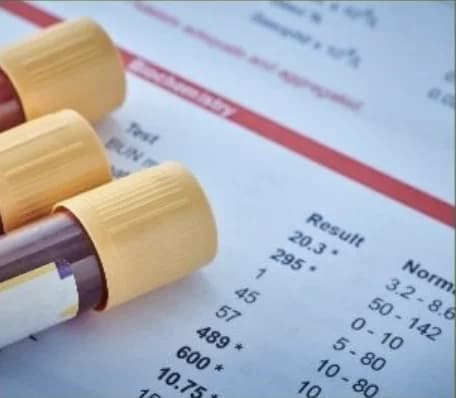


'In range' on a blood test means you are unlikely to be in acute danger. It does not mean the result is ideal for you. Standard NHS reference ranges are designed to catch disease, not to optimise health, so vitamin D, ferritin, B12 and folate can all sit inside the range and still be well below where I would want them — which is how so many people are told their bloods are fine while still not feeling it.
Something that comes up again and again in functional testing is how wide and forgiving those normal ranges are. This is what I look at instead, marker by marker, and why I would rather you tested than guessed.
What does 'normal' actually mean on a blood test?
Most laboratory ranges are built from averages across the general population — and that population includes a great many people who are not well. Sitting inside the range tells you that you look like the average. It does not tell you that you are where your body works best.
Functional reference ranges are typically much tighter, and the same result read through that lens can tell a completely different story. Equally, a number that is slightly off does not always mean something is wrong. Context is everything, which is why I never read a panel without your symptoms, history and lifestyle next to it.
Vitamin D — the clearest example
Vitamin D is the marker where the gap between normal and optimal is widest. The NHS consider 50–75 nmol/L technically adequate. What I consider the functional optimal range — for immune protection, bone strength and a happy brain — is 100–120 nmol/L. Roughly how I read a result:
- Under 25 nmol/L — severe deficiency, needing urgent correction.
- 25–50 nmol/L — insufficient; immune function and bone signalling are compromised.
- 50–75 nmol/L — technically adequate on the NHS range, but not optimal for prevention work.
- 75–100 nmol/L — a good functional baseline for most adults.
- 100–120 nmol/L — the target.
- Over 150 nmol/L — where I begin reassessing the dose.
That last line matters. Too little vitamin D is not ideal, but neither is too much — levels above 150 nmol/L may place stress on the liver and calcium regulation pathways. So my approach is always the same: test, supplement, retest, adjust. Never guess.
Why is ferritin worth asking for by name?
Ferritin is your iron store, and it can be low enough to matter while a full blood count reads as normal — so it needs testing specifically rather than assumed from the rest of the panel. This is particularly true for women and for endurance athletes. In clinic, low ferritin tends to turn up alongside poor sleep and hair loss.
But this is also the marker where guessing does the most harm. Excess iron is found in approximately one third of people with non-alcoholic fatty liver disease, and your body relies on copper to move iron out of liver cells. Iron is a mineral to correct once you know it is low, not one to take on a hunch.
B12 and folate
Both are on the baseline panel I use. B12 is often low in people eating less meat, and it is one of the nutrients H. pylori can stop you absorbing — along with iron and zinc — which is one reason a gut problem so often shows up as fatigue and brain fog.
There is a quirk here worth knowing. If you have low iron, folate or B12, it is worth checking your bilirubin, because it can reveal whether your red blood cells are dying faster than they should. Red blood cells should live for around three months, and your HbA1c is an average of blood sugar over those three months — so if they are dying early, your HbA1c may look better than it actually is. One low marker can quietly make another look fine.
Why can you be low when you eat well?
Because what you eat and what you absorb are not the same thing. When the gut wall is not intact, it becomes less selective about which vitamins and minerals it lets in. H. pylori, which many people carry without any noticeable symptoms, can block the absorption of iron, B12 and zinc.
Tablets have their own problem. Not everyone absorbs them well — especially people with digestive issues, low stomach acid, people taking a PPI such as omeprazole or lansoprazole, and people who are highly stressed. That is why, for vitamin D, I often recommend a liquid absorbed through the tissues of the mouth rather than a tablet swallowed.
Why not just take a multivitamin?
Many people come to me already taking several supplements, and zinc turns up in most of them — a multivitamin, an immune formula, a gut health product. Zinc and copper compete for the same absorption sites in the gut, so when zinc intake is consistently high, copper quietly drops. You can be taking what looks like a well-rounded regime and be creating a deficiency nobody has tested for.
Nutrients also work as a team. Vitamin D works alongside magnesium, zinc, vitamin K2 and calcium, and low magnesium can prevent vitamin D being activated at all. A single good number on its own is not the whole picture.
Getting the test right
A badly timed sample can send you chasing a problem you do not have. Test in the morning, fasted for around twelve hours and well hydrated. Skip your iron supplement on the morning of an iron panel, because it causes a temporary spike in serum iron and ferritin. And pause any high-dose biotin — found in most hair, skin and nail formulas — for 48–72 hours beforehand, since it interferes with a number of results.
The baseline panel I start most people on covers thyroid, iron, B12, folate, vitamin D, HbA1c, lipids and inflammatory markers. Functional testing sets out what else we can add, and what each test answers.
Want help making sense of your blood results? Book a one-to-one consultation tailored to your health history.
Book Consultation →Who this is not for
If a result has been flagged as abnormal, or your GP has asked you to follow something up, that comes first. Reading a panel through a functional lens sits alongside medical care, not in place of it — and never stop a prescribed medication without speaking to your GP or prescriber first.
Common questions
My GP says my bloods are normal. Should I push back?
There is no need to argue with anyone. Ask for a copy of your results with the numbers and the reference ranges on them, and have them read by someone who looks at them alongside your symptoms. The information was always there — it just needs the right lens.
Can I just test vitamin D on its own?
You can, and it is a good start if you have nothing else. But because it works as part of a team, I would rather see it alongside the rest of the baseline panel than read it in isolation.
When should I retest?
After a vitamin D injection, levels take approximately four weeks to peak, so that is when I retest. For everything else it depends on what we are correcting and how — it is part of the plan rather than a fixed rule.
The bottom line
'Normal' is a range designed to catch disease. If you feel far from well and your bloods have come back fine, the answer is not always in a new test — it is often in reading the one you already have properly, then correcting what is genuinely low rather than taking everything and hoping.
If you already have results and do not know what they are telling you, that is exactly what a consultation is for. Bring them to a free 15-minute call first and we will work out together whether it is the right next step.
This article shares naturopathic and lifestyle guidance for general education and isn't a substitute for personalised medical advice. Always speak to your GP before changing any prescribed medication or if you have an existing health condition.