
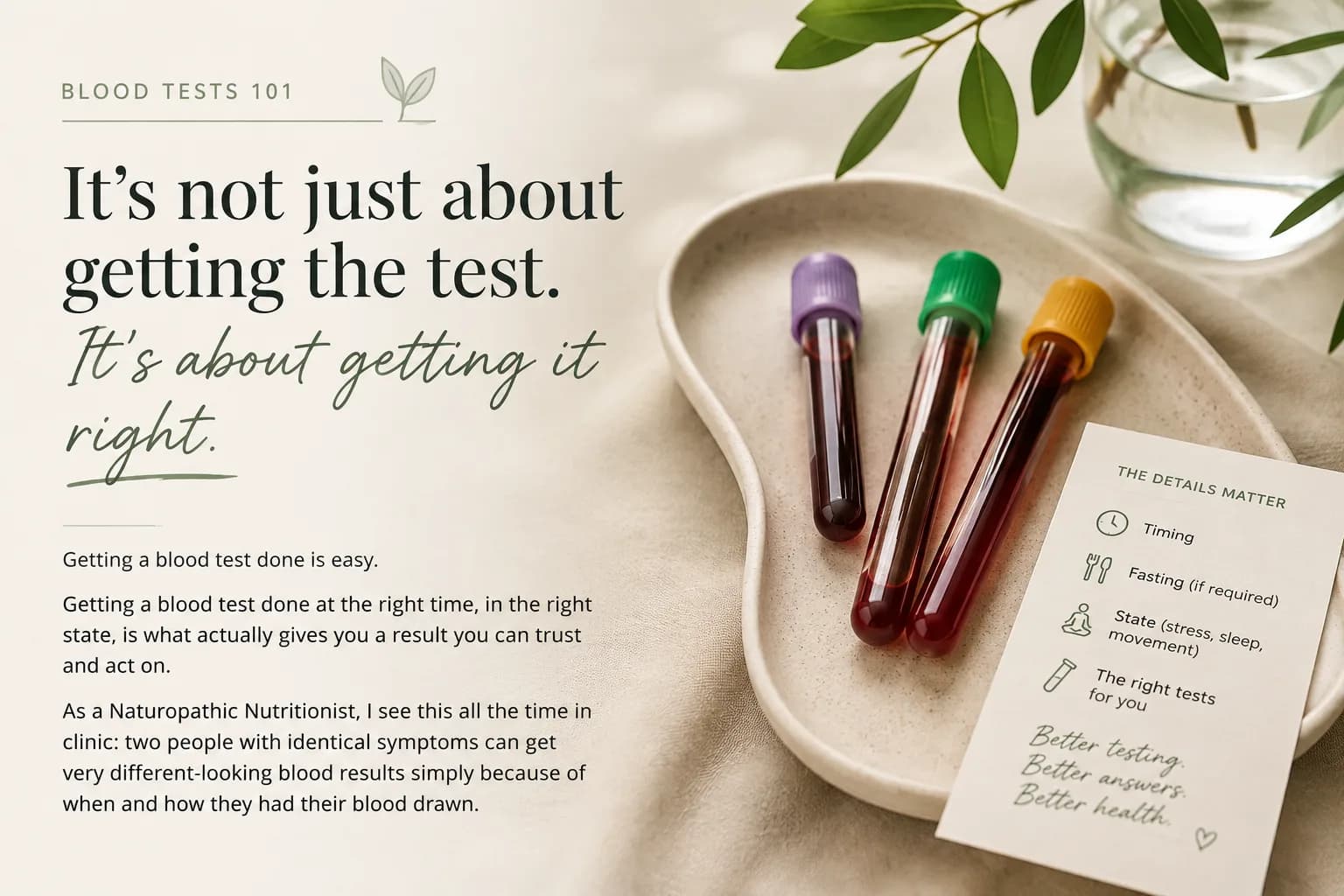
The best time to take a blood test is first thing in the morning, after a 12-hour fast, well hydrated, at least four days after your last alcoholic drink and 24–48 hours after any hard training. If you're a woman having hormones checked, day 21 of your cycle is usually the right day. If you're a man having PSA checked, keep those 48 hours clear of cycling or rowing. Everything below is the reasoning behind those rules.
Getting a blood test done is easy. Getting a blood test done at the right time, in the right state, is what actually gives you a result you can trust and act on. As a Naturopathic Nutritionist I see this constantly in clinic: two people with identical symptoms can get very different-looking results simply because of when and how they had their blood drawn.
Why Does Timing Change Your Blood Results?
Almost every marker on a blood panel moves. Cortisol has a daily rhythm. Progesterone has a monthly one. Glucose responds to your last meal, iron to your last supplement, muscle enzymes to your last workout, and PSA to whether you cycled to the clinic. None of that is a fault in the test — it's your physiology doing its job. But it does mean a badly timed sample can send you chasing a problem you don't have, or reassure you about one you do.
Below is my practitioner's guide to timing your blood test properly — for women, for men, and for everyone — so the numbers you get back actually reflect what's going on in your body.
When Is the Best Time for a Woman to Have a Blood Test?
If you're having hormones checked, the best time for a woman to have a blood test is the morning of day 21 of your cycle. In a typical 28-day cycle that's the point where progesterone should be at its peak, which gives the most honest picture of where that hormone actually sits. Counting matters here: day 1 is the first day of proper bleeding, and if your cycle is shorter or longer than 28 days, the target is roughly seven days before your next period is due. If there are no hormones on your panel, any morning works — it's the general rules further down that matter.
When day 21 testing matters most
- When symptoms suggest a hormone imbalance. If you're feeling “off” — low mood, poor sleep, heavy or irregular periods, PMS — and you're also living in a highly stressful environment, physically, mentally or environmentally, it's worth knowing where your progesterone lies. Chronic stress raises cortisol, and cortisol has a direct suppressive effect on progesterone, so the two are always worth reading together.
- When you're trying to conceive. Progesterone supports a healthy luteal phase and early pregnancy, so a day 21 level is a standard and genuinely useful step when fertility is on your mind.
- Around perimenopause and menopause. Understanding how progesterone and oestrogen are shifting relative to each other tells you far more than either hormone read in isolation.
If a more detailed option like the DUTCH Complete — which tracks hormone patterns across the whole cycle — isn't available or affordable at the time, a day 21 blood draw is the next best and most accessible way to get an accurate progesterone reading.
When Is the Best Time for a Man to Have a Blood Test?
The best time for a man to have a blood test is a morning at least 48 hours after any hard training — and if the panel includes PSA, or prostate-specific antigen, that 48 hours has to cover anything putting direct, repeated pressure on the prostate, such as cycling or rowing. That kind of activity can cause a temporary, artificial spike in PSA that has nothing to do with prostate health, and it leads to unnecessary worry and follow-up testing.
The same 48-hour window away from intense exercise also protects the accuracy of kidney markers, which are easily nudged by strenuous physical activity. If you train hard, this is the single most common reason a panel comes back looking worse than the man in front of me.
What Should Everyone Do Before a Blood Draw?
Regardless of what's being tested, these five fundamentals apply across the board.
1. Test in the morning, fasted
Morning testing, before eating, gives the most standardised and comparable results. That matters most for glucose, lipids and iron markers — and it matters again on every retest, because comparing a 9am sample to a 4pm one isn't really a comparison at all.
2. Aim for a 12-hour fasting window — no longer
Twelve hours is the sweet spot. Don't be tempted to stretch the fast well beyond that thinking it will give a “cleaner” result. An overly long fast raises cortisol, and elevated cortisol pushes up your fasting blood glucose — skewing the very thing you were trying to measure accurately. Water is fine, and encouraged.
3. Hydrate well beforehand
Aim for at least two litres of water in the lead-up to your test. Good hydration makes veins easier to find, improves blood flow, and helps prevent an artificially concentrated — haemoconcentrated — sample that can inflate several markers at once.
4. Avoid alcohol for at least four days
This is particularly important for liver function markers such as GGT and the liver enzymes, and for kidney readings, all of which are sensitive to recent alcohol intake. Four dry days before a panel is one of the easiest ways to see your actual baseline rather than last weekend.
5. Avoid high-intensity exercise for 24–48 hours
Strenuous training in the day or two before a draw temporarily raises inflammatory markers, muscle enzymes such as CK, and other values. If you trained hard yesterday, your “baseline” bloods aren't a baseline. Give yourself at least 24 hours away from intense exercise, and 48 if you can, for the most accurate inflammatory picture.
A Few More Practitioner Tips for Accurate Results
- Pause high-dose biotin supplements 48–72 hours before testing. Biotin — vitamin B7, found in most hair, skin and nail formulas — is a well-documented source of interference in tests that use immunoassay technology. It can cause falsely low thyroid (TSH) readings and falsely high readings for hormones such as testosterone. Stop it a few days beforehand and tell your practitioner you were taking it.
- Skip your iron supplement on the morning of an iron panel. Taking iron the morning of a draw causes a temporary, artificial spike in serum iron and ferritin.
- Avoid smoking and caffeine during your fasting window. Nicotine and caffeine both shift circulating levels of various markers and add noise you don't need.
- Prioritise good sleep the night before. Sleep deprivation raises cortisol in the same way chronic stress does, which can influence blood glucose, inflammatory markers and hormone readings.
- Tell your practitioner about everything you're taking. Prescription medication, over-the-counter products and supplements all interfere with specific markers — certain blood pressure medications, for example, can alter hormone ratios. A quick heads-up before your appointment means adjustments can be made, rather than an “off” result being discovered after the fact.
One important caveat: never stop a prescribed medication without medical advice, even if you think it might affect your results. Always check with your GP or prescriber first.
Want help making sense of your blood results? Book a one-to-one consultation tailored to your health history.
Book Consultation →But Remember: Your Blood Results Are Only Part of the Story
Here's the thing I want to leave you with. A blood test, however perfectly timed and prepared for, is only ever one piece of the puzzle. Numbers on a page can tell us a huge amount, but they can't tell us everything about you.
This is exactly why working with a naturopathic nutritionist, functional nutritionist or functional medicine practitioner is so valuable. It's our job to look beyond the page and ask the bigger questions. What's actually going on in your life right now? What does your family history say about your genetic tendencies? What have you been through in your past health history, and what's happening for you medically in the present? What symptoms are you living with day to day, and how do they all fit together?
It's only when we bring your blood results together with your story — your history, your genetics, your circumstances, your symptoms — that we can start to understand what's driving those markers, and more importantly what to do about them. A number that's “within range” doesn't always mean optimal, and a number that's slightly off doesn't always mean something's wrong. Context is everything.
So please don't treat your blood test as the final answer on its own. Think of it as a really valuable piece of the picture — one that means far more when it's understood alongside the whole of you.
Ready to Make Sense of Your Own Bloods?
If you're ever unsure how to prepare for a specific test, ask your practitioner directly. A two-minute conversation beforehand can save you from a confusing or misleading result later. And if you already have results in hand and don't know what they're telling you, that's exactly what a consultation is for.
If you'd like a comprehensive picture to start from, you can order an at-home 36-panel blood test with Healf and take 10% off with my link below. That is an affiliate link: Healf pay me a small commission if you order through it, the 10% still comes off your price, and it costs you nothing extra. I am telling you so you can weigh it.
Niki Charnock DipNT, mBANT — CF Organic Wellness
This article is written for educational purposes and does not constitute medical advice. Always consult a qualified healthcare professional before making changes to your health regime, and never stop prescribed medication without speaking to your GP or prescriber first.